
Costa da Caparica is the easiest place to learn to surf near Lisbon — and one of the most consistently swell-rich stretches of sand on the entire Portuguese coast. It sits just across the 25 de Abril Bridge, gets sun on more than 280 days a year, and offers soft, beginner-friendly waves in summer that pick up strength in spring and autumn. This guide has everything you need to plan a surf getaway or your first lesson: the best beaches to surf depending on your level, the best time to come, water temperature and what wetsuit to bring, exactly how to get here from Lisbon, and how to take your first lesson safely. It's written from the sand — we teach lessons here every day.
Quick answer: Costa da Caparica is ideal for beginner and intermediate surfers. The best time to learn is from May to October, when the waves are smaller and the water is warmer. It's about 20–30 minutes from central Lisbon by car, or around 45–55 minutes by public transport. Beginners should head to the northern beaches (Praia do Norte / Praia de Santo António / CDS), where the waves are gentle and the bottom is sandy.
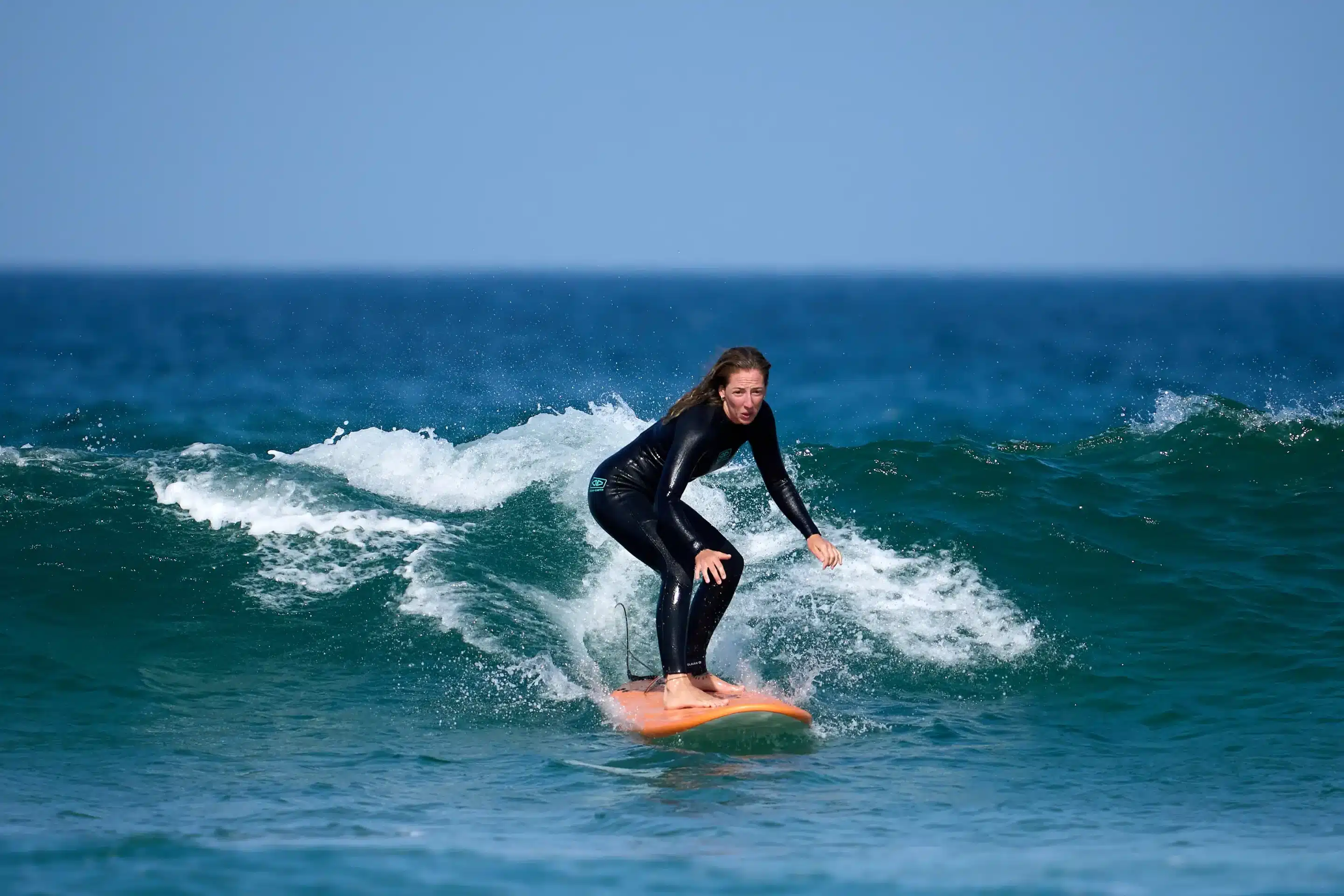
Why surf in Costa da Caparica?
Costa da Caparica is a long, almost continuous stretch of sand that runs south from the mouth of the Tagus. There are several reasons that make it special for surfing:
- It's a sandy-bottom beach (beach break). No rocks, no reef. If you fall — and beginners fall a lot — you land on sand and water, not on anything that hurts. It's the number one reason this is a beginner-friendly beach.
- It works almost all year round. The coast faces west and picks up Atlantic swell consistently, so there's almost always some wave to catch. Summer brings gentle waves; autumn and spring bring size and power for those looking to progress.
- It's right next to Lisbon. You can be surfing half an hour after leaving the city, which lets you combine a visit to Lisbon with a proper surfing session — no need to rent a car.
- It has infrastructure. Certified surf schools, board and wetsuit rental, beach cafés, changing rooms, lifeguards in season, and paid parking right by the sea.
- It's a sandy-bottom beach (beach break). No rocks, no reef. If you fall — and beginners fall a lot — you land on sand and water, not on anything that hurts. It's the number one reason this is a beginner-friendly beach.
For absolute beginners, this combination — gentle waves, sandy bottom, easy access, and qualified instruction — is hard to beat anywhere in Europe.
Best beaches to surf in Costa da Caparica (by level)
Costa da Caparica isn't a single beach, but a series of named praias (beaches) linked by a long boardwalk. Conditions change as you head south. Here's a rundown.
For beginners
Praia do Norte / Praia de Santo António / Praia do CDS — the beaches to the north, closer to the town and the bridge, are the classic area for learning to surf. The waves here are typically softer and more forgiving, with plenty of whitewater (the foam after a wave breaks), which is where you'll catch your first waves. This is where most surf schools, including ours, teach lessons. The sandbanks shift throughout the year, but a good instructor reads the tide and picks the safest, most surfable spot for the day.
For progressing and intermediate surfers
As you move further south along the coast, the beaches get less crowded and the waves can become a bit better defined — better for practicing green-wave take-offs and turns. Praia da Rainha and the area around Praia do Tarquínio are good progression spots when conditions allow. They reward those who can already stand up comfortably and want to start reading and picking waves.
For experienced surfers
The beaches further south, toward Fonte da Telha, are quieter and can pick up more swell. With the right swell and tide, Caparica's outer sandbanks produce powerful, hollow waves sought out by experienced surfers. These spots are less suited to beginners and have fewer amenities, so come prepared.
Local tip: The "best" beach on any given day depends on swell direction, wind, and tide. Don't fixate on a name — pay attention to conditions instead. If you're learning, this is exactly what your instructor takes care of for you.
When is the best time to surf in Costa da Caparica?
There's no closed season here — just different seasons for different surfers.
- Summer (Jun–Sep) — Smaller, gentler, frequent | Busiest | Beginners, families, first-timers
- Autumn (Oct–Nov) — Bigger, cleaner, with power | Quieter | Progressing and intermediate surfers
- Winter (Dec–Feb) — Biggest, most powerful | Emptiest | Experienced surfers
- Spring (Mar–May) — Building, variable | Quiet | Progressing surfers, great value
If you're learning to surf, come between May and October. The waves are at their most beginner-friendly, the water is warmer, and the long days give you more session options. Beginner lessons still run safely for much of the year — the trick is matching the day's conditions to your level, which is exactly the point of going with a certified school.
Water temperature and what wetsuit to wear
The Atlantic off Lisbon is bracing rather than warm. Quick guide:
- Summer (Jun–Sep): water around 17–20°C. A 3/2mm wetsuit is more than enough.
- Spring and autumn: water around 15–17°C. A 3/2mm still works; a 4/3mm is more comfortable.
- Winter (Dec–Feb): water around 14–15°C. A 4/3mm wetsuit, and many surfers add boots.
If you book a lesson or rent from a school, the wetsuit is provided and matched to the season — so you don't need to own one to try surfing here.
How to get to Costa da Caparica from Lisbon
Costa da Caparica is about 11 km from central Lisbon, on the south bank of the Tagus. You have three realistic options.
By car or taxi/Uber (fastest)
Cross the 25 de Abril Bridge onto the A2/IC20 and follow signs for Costa da Caparica. It's about 20–30 minutes by car outside rush hour. A taxi or Uber from the city center typically costs €18–€30, depending on traffic and demand. There's paid parking along the boardwalk near the beaches.
Avoid crossing the bridge during rush hour (roughly 8–9:30am and 6–8pm) — it's the main traffic bottleneck.
By direct bus (easiest without a car)
The Carris Metropolitana 3710 bus is the main direct connection. It departs from Areeiro in Lisbon (take the green metro line to Areeiro station and walk to Av. Padre Manuel da Nóbrega) and runs to the Costa da Caparica terminal in about 55 minutes, with departures every 10–30 minutes depending on the time of day. From the terminal, it's about a 10-minute walk to the beach.
By ferry ("cacilheiro") + bus (the scenic route)
Take the ferry ("cacilheiro") from Cais do Sodré to Cacilhas (about 10 minutes crossing the river), then a bus from Cacilhas to Costa da Caparica (the 3011 service and similar, about 35–45 minutes). The river crossing is the most scenic way to get there and breaks up the journey.**
Joining us for a lesson? We're at Praia de Santo António – Apoio 8, on the northern beaches. We send the exact meeting point and directions with every booking confirmation, so you won't get lost.
How to take your first surf lesson (and why a certified school matters)
You can, technically, rent a board and paddle out on your own — but if you've never surfed before, a lesson will get you standing up faster, keep you safe, and teach you the unwritten rules of the line-up.
Here's what a good beginner lesson in Costa da Caparica looks like:
- Get kitted out — You put on a wetsuit and a soft-top beginner board (much safer and easier than a hardboard).
- On the sand. The instructor explains ocean safety, how to read the beach, paddling technique, and the pop-up — how to go from lying down to standing up.
- In the water. You start in the whitewater, standing depth, close to shore, always with guidance, catching the foam of already-broken waves. Most people stand up on their very first day.
- Feedback — A good coach watches every attempt and gives you one thing at a time to fix, so you actually progress within the two hours.
Why "certified" matters: in Portugal, legitimate schools are accredited by the Federação Portuguesa de Surf (FPS) and registered with Turismo de Portugal. This accreditation means insured students, qualified instructors, and real safety standards. Always confirm this before booking — it's the clearest sign you're in good hands.
What's usually included
- Surfboard and wetsuit
- 2-hour lesson with a certified instructor
- Accident insurance
- Safety briefing and technique training
What to bring
Just a swimsuit (to wear under the wetsuit), a towel, sunscreen, and water. Arrive 10–15 minutes early so you have time to get kitted out calmly.
Surf Costa da Caparica with Gecko Surf School
We're an FPS-certified surf school (No. 432), registered with Turismo de Portugal (No. 468/2020), on the northern beaches of Costa da Caparica since 2016. We teach all levels — from absolute beginners to surfers looking to refine their technique — in small groups, with all equipment included.
- Group surf lessons – €30, ideal for beginners and progressing surfers, in a fun, motivating environment.
- Private surf lessons – €80, one-on-one coaching for faster progression.
- Semi-private lessons – €90 for two, perfect for couples or friends.
- Lesson packages – the best value for those who really want to learn, not just try it once.
Children are welcome from age 6, and if the sea isn't safe on your day, we'll reschedule at no cost or give you a refund. Book your Costa da Caparica surf lesson here.
Frequently Asked Questions
Is Costa da Caparica good for beginner surfers?
Yes — it's one of the best spots for beginners in Portugal. The northern beaches have gentle, sandy-bottom waves and plenty of whitewater, which is exactly what you need to learn. Most beginners catch their first waves in their very first lesson.
Can you surf Costa da Caparica all year round?
Yes. The coast picks up Atlantic swell all year round. Summer waves are smaller and the water warmer (better for learning), while autumn and winter bring bigger, more powerful waves for experienced surfers.
How far is Costa da Caparica from Lisbon?
About 11 km — roughly 20–30 minutes by car via the 25 de Abril Bridge, or 45–55 minutes by public transport (direct bus 3710 from Areeiro, or the "cacilheiro" ferry from Cais do Sodré to Cacilhas plus a connecting bus).
Do I need to know how to swim to surf here?
Yes, you should know how to swim and feel comfortable in the water. You don't need to be an expert — beginner lessons take place in standing-depth areas near the shore, always under the instructor's supervision.
What wetsuit do I need for Costa da Caparica?
A 3/2mm wetsuit works for summer and most of spring/autumn; a 4/3mm is more comfortable in the colder months. If you take a lesson or rent equipment, the wetsuit is provided and matched to the season.
How much does a surf lesson cost in Costa da Caparica?
Group lessons typically start around €30 for 2 hours, with all equipment and insurance included. Private and semi-private options cost more for personalized attention. Multi-lesson packages offer the best value.
Which is the best beach in Costa da Caparica for surfing?
For beginners, the northern beaches (Praia do Norte / Santo António / CDS). The "best" beach on any given day depends on the swell, wind, and tide — which is why learning with a local instructor who picks the right spot makes all the difference.
If you're thinking about getting started, check out our surf lessons in Portugal and choose the format that suits you best.